Thursday, November 7, 2019

Our Top 3 Uses for Lemon Essential Oil


If you think about a smell that’s commonly associated with cleanliness and pleasantness,  the first one that pops into your mind would most probably be lemon or other citrus scents. Just smelling citrus can be refreshing, but that’s not all to it.
For today’s post, we’ll be focusing on Lemon Essential Oil, whose scent can perk you up. It’s purported to have powerful anti-microbial activity, and it can disinfect surfaces. Some also swear that it can help improve the condition of your skin, reduce excess sebum production, and eliminate dandruff! With so many uses for this amazing essential oil, it can be a little overwhelming for those who don’t know where or how to start using it. So, here’s our Top 3 uses for it!
craftiviti lemon essential oil yein and young
1. Air Freshener
Don’t have good ventilation at home? Dislike the smell of cooking/food permeating your space after you’re done eating, or simply want to freshen up spaces that feel stuffy/has stale air? You can add up to 20 drops of lemon essential oil to 18ml of water in a 20ml Amber Spray Bottle and give it a good shake before spraying the area.
Pssst! All citrus-type essential oils are photosensitive. It’s best to keep them in amber glass bottles to protect them from UV light, and also because they break down plastic bottles.
If you’re not a fan of multiple shakes before using this spray, you can add in Polysorbate-20 (an emulsifier which is used to bring small amounts of oils into a watery environment). The amount of Polysorbate-20 that you’ll need to add is equivalent to the amount of lemon essential oil added. So…
With Polysorbate-20
20 drops of Lemon Essential Oil + 20 drops of Polysorbate-20 + 18ml of Water
Without Polysorbate-20
20 drops of Lemon Essential Oil + 18ml of Water
51
2. Facial Oil
Anti-inflammatory, antioxidant, detoxicant, and balancing is just a few of the properties and benefits lemon essential oil has for the skin. By adding 12 drops of lemon essential oil to 30ml of jojoba oil + sweet almond oil, you’ll get a moisturizing, skin balancing, detoxing and relieving, anti-inflammatory and antioxidant facial oil. All you need is a amber bottle with a dropper cap to store this facial oil.
Pssst! This works as a body and hair oil too! When applying to your hair, use it as a hair oil mask. Leave it in your hair for a minimum of 15 minutes before shampooing and rinsing.
12 drops of Lemon Essential Oil + 15ml of Jojoba Oil + 15ml of Sweet Almond Oil
*Note: If this oil is too ‘heavy’ for you, you can reduce the amount of jojoba oil and increase the amount of sweet almond oil instead.
Fresh lemon with lemon essential oil on white background.
3. Insect Repellent
Thanks to the tropical weather we experience in Malaysia, there’s an abundance of bugs and lizards everywhere and not many of us are fans of them. Add 10 drops of lemon essential oil, 15 drops of tea tree essential oil or eucalyptus essential oil and a pinch of menthol crystals to some refined coconut oil in a wall burner. Allow the scent to envelop your room and you’ll have a pretty efficient insect repellent that also has other aromatherapeutic benefits like clearing blocked noses and boosting your mood!
10 drops of Lemon Essential Oil + 15 drops of Tea Tree / Eucalyptus Essential Oil
+ a pinch of Menthol Crystals + Refined Coconut Oil
happy craftingbuy it

Saturday, October 26, 2019

DIY Melt and Pour Anti-Acne African Black Body Soap


Originated from West Africa, African Black Soap is traditionally hand-made using methods passed down through generations, using recipes that are centuries old. It’s a brilliant soap packed with antioxidants, vitamins A and E, fatty acids, and more, because of the plantain and palm leaves, banana bark, cocoa pods and shea butter. This makes it a ‘holy grail’ soap for us skincare enthusiasts!
So, what can African Black Soap do? It can…
  • balance skin moisture levels without making it oily
  • nourish skin
  • heal skin problems like acne, eczema, and psoriasis
  • fade skin discolorations and reduce hyperpigmentation
  • relieve dry and irritated skin
  • even skin texture and tone
  • deep cleanse for skin
  • natural exfoliation for skin
In fact, there’s a study by the Albert Einstein College of Medicine which found that over 90% of African black soap users who were a part of their study, reported to being satisfied with their improvement in acne, eczema, and general skin quality!
PS: It’s important to buy authentic, raw African Black Soap. There are “black soaps” in the market which contains artificial ingredients, thus they won’t give you the same results as authentic, raw African Black Soap.
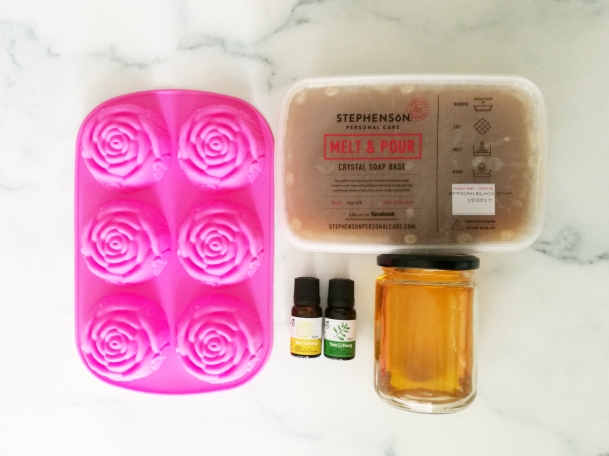
For this recipe today, we’ll be using Stephenson Personal Care’s Crystal African Black Soap (click here for more info!) base which is a completely natural Melt & Pour soap base “made using Raw African Black Soap from Ghana.”
bty
What You’ll Need:
  1. Stephenson Personal Care’s Crystal African Black Soap Base
  2. Calendula Infused Oil (made following this tutorial, or you can just get our 100% Calendula Oil if you prefer something quicker!)
  3. Tea Tree Essential Oil
  4. Lemon Essential Oil
  5. Silicone Mold 👉 We used this Large Rose Soap Mold here!
  6. Double Boiler
  7. Measuring Spoon
Instructions:
  1. Cut 500g of soap base and melt it in a double boiler.
    bty
  2. Turn off heat when melted and add up to 1ml of Calendula Oil, 10 drops of Tea Tree Essential Oil and 10 Drops of Lemon Essential Oil into the melted soap base. Stir well.
  3. Pour the melted soap base into a silicone mold.
  4. Set aside for 4-6 hours so that it can fully harden. You can use the soap immediately after!
bdr
Pssst! You can also use this soap just as it is!

happy crafting
buy it
Reference:
  1. Lin, A., Nabatian, A., & Halverstam, C. P. (2017). Discovering Black Soap: A Survey on the Attitudes and Practices of Black Soap Users. The Journal of clinical and aesthetic dermatology, 10(7), 18–22.

Friday, October 18, 2019

Flashback Friday – 5 Times Juniper’s Journal Talked About Us


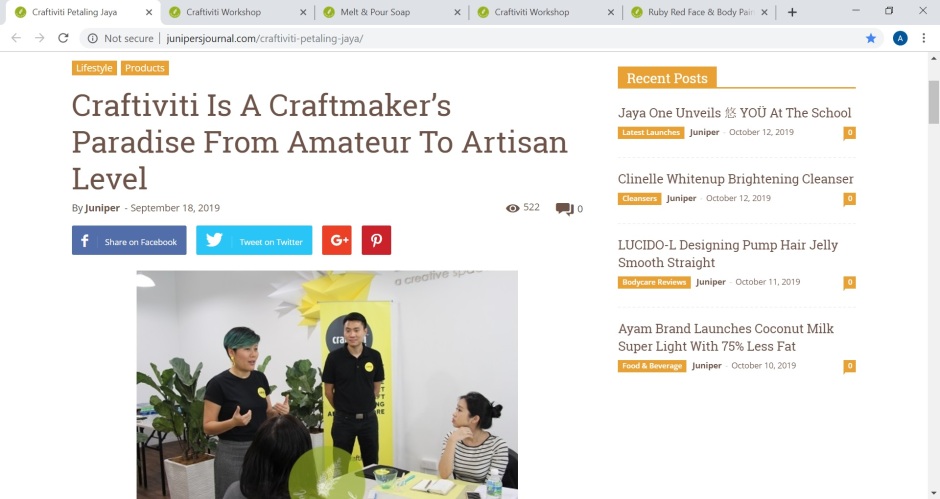
Recently, we noticed another amazing person (a.k.a. Juniper of Juniper’s Journal) who talked about us on their blog and we are so so delighted and thankful that her experience with us was just as amazing as our experience with her.
Junipers Journal Craftiviti Blog Feature
All her posts on us (click on the individual titles to read each post!):
  1. Craftiviti Is A Craftmaker’s Paradise From Amateur To Artisan Level
  2. Craftiviti Workshop : Handmade Lotion
  3. Craftiviti Workshop : Melt & Pour Soap
  4. Craftiviti Workshop : Foaming Bath Butter
  5. Ruby Red Face & Body Paint Available At Craftiviti

Thank you so much for featuring us Juniper!
happy craftingbuy it

Monday, October 14, 2019

How Plant Powders Are Made


In forms like extracts, oils and powders, plants have always been incorporated in skincare. For instance, rose is popular for being antibacterial, anti-inflammatory, and having antioxidants—usually infused in products meant to fight acne, reduce redness, boost moisture in skin. Orange is added for it’s richness in vitamin C which helps to even out your skin tone, and aloe vera is a known healing plant.
There’s also ginger root which can help stimulate blood circulation, and pine bark extract with it’s ability to increase hydration and elasticity of skin. So, it’s clear that when used in the right way, plants can do wonders for our skin!
Natural oraganic homemade soap making
For today’s blog post, we’ll be talking about how plant powders—one of the forms in which plants are incorporated into skincare—are made. Like how there is a variety of plant powders, there’s also a few ways to produce them.
~ * ~
moringa_powder1. Grinding into Fine Powder
Powders like green tea powder, mint powder and moringa leaf powder are made using the leaves of their plant which has been dried and then, ground into fine powders. This is also how some ginger root powders, flower powders (like lavender, rose, calendula, etc.) and a few others are made.

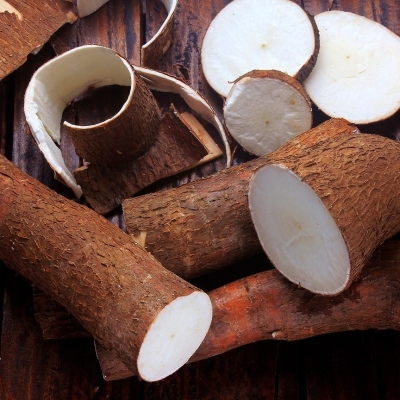
fresh cassava and peels and slices on rustic wooden table2. Starch Production
Certain plant powders like arrowroot powder are actually starch. These plant powders are made by separating the starch from plant root which has been cut and mashed into pulp. This pulp is strained through a screen to obtain fine starch which is then, dried and ground into fine powder.

3. Spray Drying
organic_strawberry_powder
While some powders like lemon powder and beetroot powder can be made by grinding the rind (for lemon) or the entire root (for beetroot), there’s another way for these powders to be made and that’s spray drying. This process involves spraying concentrated fruit juice in a chamber with hot air, allowing the droplets to dry before the dried particles are separated and filtered. Some of Craftiviti’s plant powders that are created through this process are Organic Lemon Powder, Organic Strawberry Powder and Organic Mango Powder.
~ * ~
Among the three, it can be said that plant powders made using the spray drying and grinding processes would hold the most nutrients and are therefore, more beneficial to us. However, this doesn’t mean that plants powders that are essentially starch, aren’t beneficial at all. All plant powders have their own pros and cons. So, depending on which formulation they’re incorporated in, they can either give your DIY personal care products a boost, or not.

Thanks for reading! We hope this helps ❤️

happy crafting
buy it

Thursday, October 10, 2019

Flashback Friday – Female Magazine Featured Us!


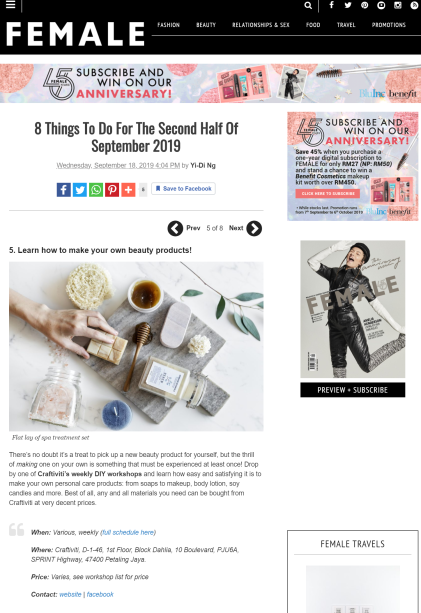
On the 18th of September, Female Magazine (a.k.a. Malaysia’s leading fashion & beauty magazine) featured us in one of their articles and we’re tickled pink!
female magazine
You can read the full article here!
Also, if you’re in Malaysia, near Petaling Jaya and would love to be a part of any of our craft workshops, head over here to see what we have and book your spot as well ❤️

Thank you so much for featuring us Female Magazine!
happy craftingbuy it

Monday, October 7, 2019

Berry Refreshing Natural Lip Balm DIY


Chapped lips aren’t a pretty sight, especially when the skin is peeling and there’s blood (ouch!). So, aside from drinking lots of water (don’t over-drink, though. Water poisoning isn’t pretty either), you give your lips a hand in the moisturizing department by applying lip balm 😍
Pssst, we’ve a printable recipe card for this one too, so grab it from down below!
bty
What You’ll Need:
  1. Beeswax 👉 We used Natural Refined Beeswax Pastille (USA) here!
  2. Refine Shea Butter
  3. Sweet Almond Oil
  4. Refined Coconut Oil
  5. Pomace Olive Oil
  6. Peppermint Essential Oil by Yein & Young
  7. Mixed Berries Lip Balm Flavor
  8. (Optional) Craftiviti’s Lip Liquid – Red 👉 You can choose among various shades of red, but our go-to is Red 21.
  9. Glass Pipette
  10. Metal Scoop/Glass Beaker
  11. Cooking Pan/Pot
  12. Glass Stirrer
  13. 5 Lip Balm Tubes (5ml each)
  14. Kitchen Scale
Instructions
  1. Add 2 tbsp of Natural Refined Beeswax Pastille and 1 tbsp of Refined Shea Butter in the metal scoop/glass beaker.
  2. Place the metal scoop/glass beaker over a pan of water on a stove, and melt the contents. Stir occasionally to make sure the contents melt evenly.
    Berry Refreshing Natural Lip Balm DIY (1)
  3. Once melted, add 1 tbsp of Sweet Almond Oil, Refined Coconut Oil, and Pomace Olive Oil. Stir until it’s evenly blended.
  4. Remove the metal scoop/glass beaker from the pan.
  5. Add 5 drops of Mixed Berries Lip Balm Flavor, and 2 drops of Peppermint Essential Oil. Stir to blend.
  6. (Optional) Add in up to 5 drops of lip liquid to give your lip balms a light tint! Stir to blend again.
    Berry Refreshing Natural Lip Balm DIY (2)
  7. Pour mixture into lip balm tubes. Set it aside for it to harden and cool before capping the lip balms.
    *Note: Make sure that your lip balm containers are screwed all the way down before pouring your mixture in, or you’ll end up with short lip balms!

Craftiviti Recipe DIY Instructions 2-Berry Refreshing Natural Lip Balm

happy crafting
buy it

JOIN US ON FACEBOOK